To keep your marble floor, worktop or bathroom looking as good as the day it was installed, it is essential to apply careful maintenance. Read on for our top tips on how to clean marble anywhere in your home.
How to Clean Marble Floors
Marble is a soft stone. The measurement on the MOHs hardeness scale is usually between 2-3. To put this into context, diamond is a 10 on the scale and talc is measured at 0. For this reason it is essential that you keep your marble floor free from scratch hazards. Good quality matting at each entrance to your home will pick up a lot of the dirt, sand and small stones which can scratch your floors. Having a ‘shoes off policy’ in the house will also help to reduce the amount of abrasion to a stone surface from foot traffic.
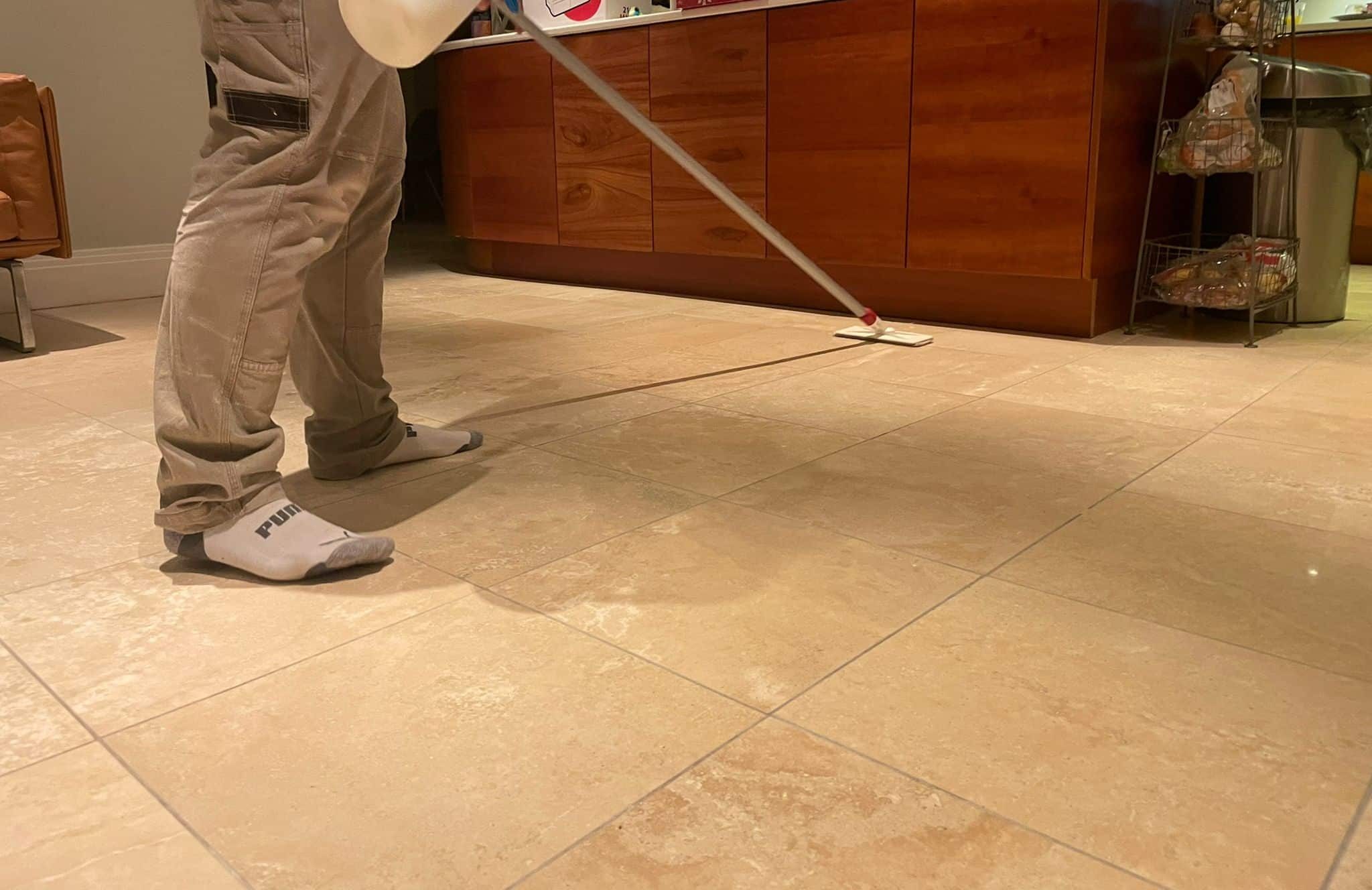
Daily maintenance is the best way to keep on top of any particles that do find their way into your home. Frequent use of a soft long-hair Swiffer will remove a lot of the small particulates which can scratch and dull your floor.
When you then apply the Swiffer to the floor it will attract dirt, hair, dust and loose debris. It is a lot quicker than vacuuming and much kinder to your stone.
When your marble floor needs a clean, it is important to us a pH neutral cleaning detergent. Many common household cleaners are acidic and will damage your stone. Acidic products react with the calcium carbonate in marble causing a chemical burn known as an etch mark. Faber Floor Cleaner is our recommendation for a maintenance cleaner that is pH neutral and very effective.
How to Clean Marble Worktops
In a kitchen, the acid sensitivity of marble is particularly pertinent as everyday acids such as vinegar and fruit juices can easily come into contact with your stone. We recommend using trays and coasters to store these products to prevent them from coming into contact with your marble worktop. When spillages do occur, it is essential to ensure that you blot the liquid rather than wiping it. The acid etching will be almost instant and so wiping the liquid across the surface will further exacerbate the damage.
Faber Clean360 is an all surface cleaner which is ideal for natural stone. Spray this cleaner directly on your marble to kill bacteria and break down grease, just as you would with any other surface cleanser. You should then use a soft, dry cloth to wipe down your worktops. As it does not leave any residue you will not need to rinse and the surface dries very quickly. As the detergent is very mild, you can use this detergent on a daily basis and multiple times a day.
How to Clean Marble Bathrooms
It is important in a bathroom to think about the cleaning products used throughout the bathroom. We recommend you replace all surface cleaners in your house with Faber Clean360 as it is just as effective as other surface cleaners on all surfaces, not just stone. This includes porcelain tiles, leather, laminate flooring, steel and glass. Replacing all cleaners in your home with a stone safe alternative removes the possibility of accidentally using the wrong type on your stone surfaces. Faber Ciao Cal is a stone-safe limescale remover ideal for cleaning taps and shower screens surrounding stone surfaces.
We recommend that you clean your shower and bath area daily. The easiest and most effective way is to spray the walls and floor of the stall with a stone safe cleaner, then squeegee down after everybody in the home has taken a shower for the day. This will stop hard water build ups to the surface of the stone. Tap water is not always PH neutral which means that over time, this can have impact your stone. In hard water areas sitting water can lead to a build-up of limescale and mineral deposits which can be tricky to remove without risking damage to the stone surface. Try to ventilate your bathroom as much as possible too. Bathrooms with inadequate ventilation can cause stone surfaces to suffer from moisture damage and even mould and mildew growth.
How to Clean Dark Stone
For dark coloured stone surfaces particularly, we recommend periodic reapplication of a colour enhancing sealant such as Faber P147+. This will maintain the level of protection from water and oil based penetration, but will also maintain the deep colour and aesthetics. Pour a small amount onto a microfibre cloth and apply to the stone surface in small circles until you have covered the whole area. Buff any residue with a fresh cloth and leave to dry naturally.
Acidic spills will still damage a stone that has been sealed, and colour enhancing sealant won’t reverse this damage. However it will mask the aesthetic impact by reducing the colour difference caused by the etch.
How to Clean Marble Professionally
If in doubt, it is always worth consulting an expert. Our services include cleaning, restoration and polishing of all marble and stone surfaces and you can read more about this here.