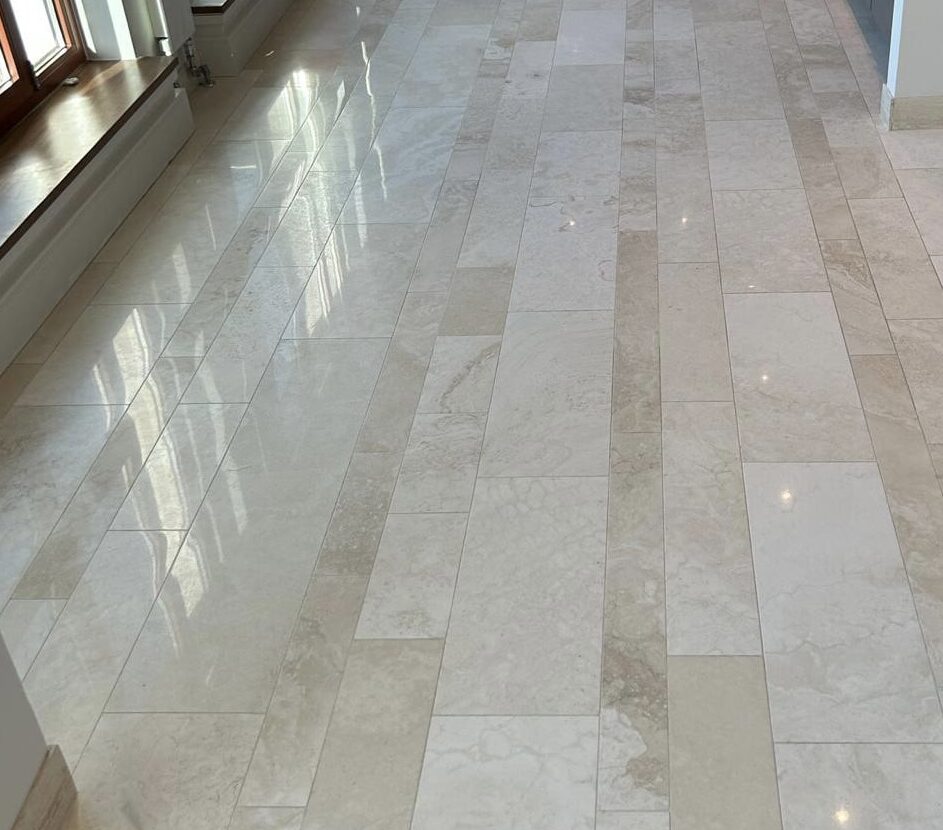
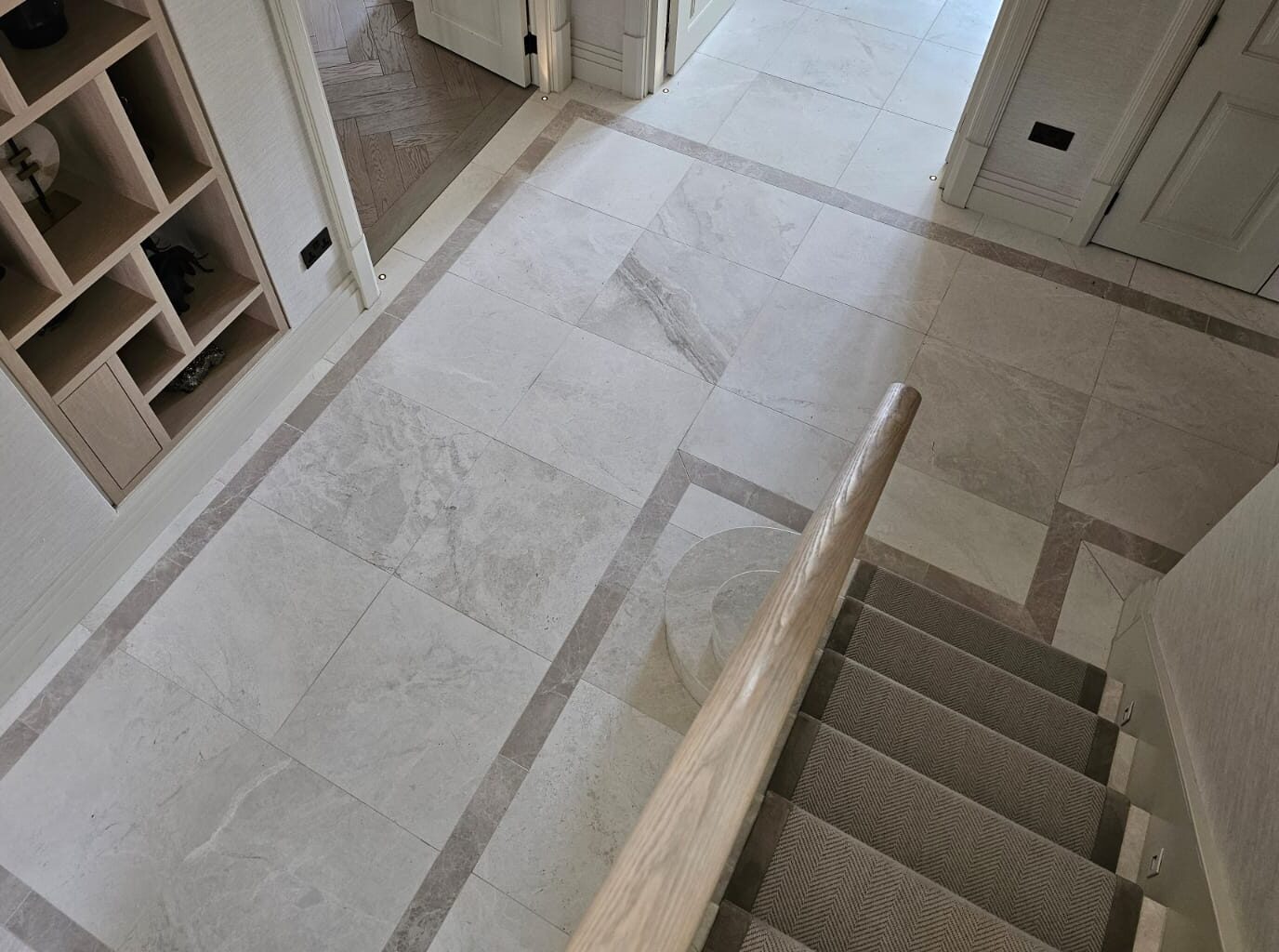
It couldn’t be more straightforward when it comes to how to clean a limestone floor. It’s a popular choice for kitchens, dining rooms and entrance halls. With the right care and attention from day one it will last forever.
How to clean a limestone floor… before you start cleaning
The first thing that you can do to look after your limestone is to protect it from anything that could scratch it. Limestone is softer than you might think. This doesn’t mean you need to walk around with cotton wool on your feet, but you should try to keep everyday abrasions to a minimum. Over time, tiny scratches from foot traffic will mount up to dull the surface of the stone. We recommend asking guests to take their shoes off in order to minimise this impact.
It is also sensible to make sure that there is a good quality mat installed at each entrance to the property. The micro scratches from shoes might not be noticeable, but if a stone is dragged onto the floor, you will soon spot it. Although deep scratches can be restored, it is always better to avoid them. Adding a felt pad to the bottom of furniture will also help to prevent this too.
How to clean a limestone floor… each day
It might sound daunting to suggest a daily cleaning regime. But what if I told you that you’ll never need your vacuum cleaner again? We recommend sweeping the floor each day instead. It is kinder to your stone and quicker too. A quick pass of a soft, long haired Swiffer across the floor will attract any dust and particles that have made their way into the house. This reduces the chance that they will be tread into the stone or scratch it by being carried around the floor.
How to clean a limestone floor… using the right product
Choosing the correct cleaning detergent is the most important part of looking after your stone. The beautiful fossils that create your unique tiles are also what gives the stone its most distinctive quality – that it is sensitive to acid. The calcium carbonate in the stone will react with anything acidic that it comes into contact with and cause an etch mark. This is usually seen as a dull or white patch on the surface and cannot be wiped away. This means that you will need to be careful to choose a cleaning product that does not contain acids. Some off-the-shelf detergents can also be highly alkaline and this can also impact the sealant on your stone.
The good news is that it not difficult or expensive to find the right product. We recommend Faber Floor Cleaner which is easy to buy online and not expensive either. You will also be able to find appropriate products on supermarket shelves. The key is to make sure that the bottle lists ‘limestone’ or ‘natural stone’ on the label or that it describes itself as being pH neutral. It is important not to mix this up with ‘eco-friendly’ or ‘sustainable’ as these are not the same thing.
How to clean a limestone floor… that is textured or tumbled
Most natural stone is porous. When it is first installed, an impregnator is applied which is designed to protect your limestone. This binds to the capillaries within the stone and means that anything that drops onto the surface shouldn’t penetrate and cause lasting damage. If you have a very porous tile or a textured or tumbled stone, you may have also had a topical sealant or wax applied.
Either way, it is important not to over-wet the floor when you are cleaning. The repeated impact of water or steam cleaners will start to open up new capillaries in the stone. These will not be protected in the same way. For those with a topical sealant, this will also start to degrade. We recommend using a low moisture mop system to help look after your stone while you clean it. Ringing out as much water as possible will ensure that water isn’t left to pool. Sitting water will also have a habit of finding its way into grout lines. If this is the runoff from the dirty tiles, it will quickly make the grout look grubby and this can be trickier to clean that the stone!
How to clean a limestone floor… professionally
Every now and then you may consider a professional deep clean or restoration service. This might be due to the stone having been damaged or just because over time the surface has dulled. There are no set rules about how often a stone floor should be restored or ‘resealed’. Many people will never have any professional treatment for their stone floor. However, if you are starting to notice that it is difficult to keep clean, then this could be a sign that it needs a refresh. To find out more about the services that we offer for limestone, please call or drop us an email.
info@athenastonecare.co.uk | 07824 193 339